







Introduction:
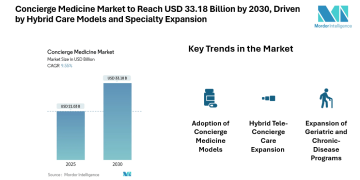
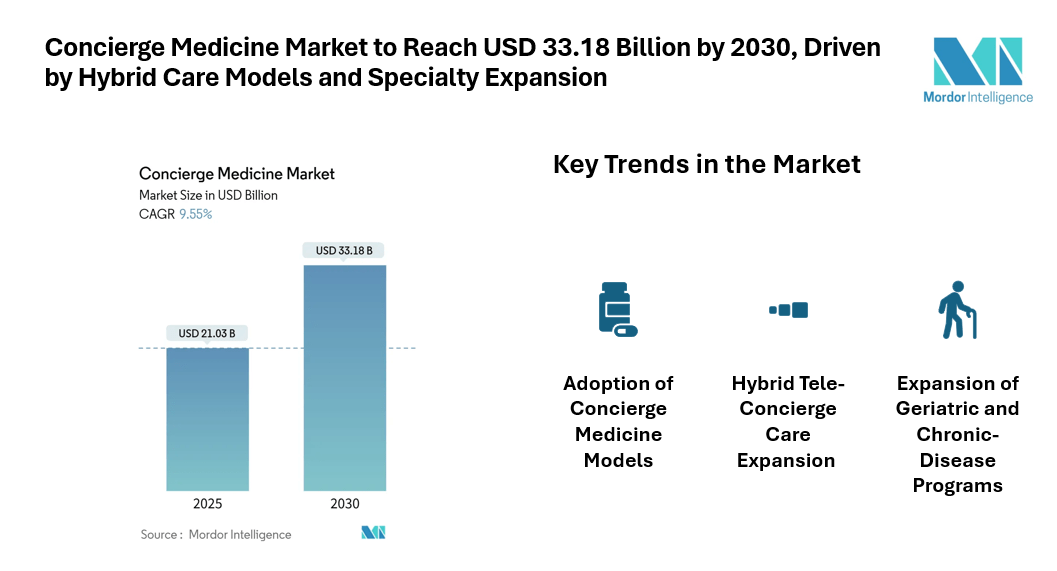
The Concierge Medicine Market size is estimated at USD 21.03 billion in 2025, and is expected to reach USD 33.18 billion by 2030, at a CAGR of 9.55% during the forecast period (2025-2030). The rising demand for personalized healthcare, hybrid in-person and virtual care models, and expanding specialty services are key factors fueling the market’s expansion. North America currently leads the market in terms of size, while Asia-Pacific is emerging as the fastest-growing region, supported by private insurance adoption and hospital-at-home initiatives.
Concierge medicine offers a subscription-based model where patients gain enhanced access to physicians, preventive care, and chronic-disease management programs. This approach emphasizes relationship-based healthcare, allowing for more personalized, timely, and continuous medical attention. Increasing interest from affluent patients as well as middle-income groups has contributed to the growing concierge medicine market size, reflecting changing preferences in healthcare delivery.
Key Trends in the Concierge Medicine Market
- Adoption of Concierge Medicine Models
Physicians are shifting from traditional high-volume, fee-for-service models to retainer-based practices. This migration provides better work-life balance for doctors while offering patients more dedicated and personalized care. Younger and female physicians are joining concierge practices at a faster rate, introducing innovative service packages tailored for families, millennials, and Gen Z patients. This trend strengthens the concierge medicine market growth by broadening demographic reach.
- Hybrid Tele-Concierge Care Expansion
The adoption of hybrid models that combine in-person visits with telemedicine, secure messaging, and home diagnostics is accelerating market expansion. Such platforms extend healthcare access beyond geographical boundaries and offer greater convenience for patients. During the pandemic, telehealth integration surged, and today, a significant portion of concierge practices operate with telehealth capabilities, enhancing patient satisfaction and retention.
- Rising Demand for Personalized Healthcare
Patients increasingly value proactive and individualized care. Concierge practices emphasize longer consultations, tailored preventive plans, and continuous monitoring for chronic conditions. Surveys indicate improved patient access and higher trust in physicians within concierge programs, leading to better adherence to treatment plans. These factors contribute positively to the concierge medicine market analysis.
- Expansion of Geriatric and Chronic-Disease Programs
In developing regions, particularly Asia-Pacific, private insurers and hospital networks are introducing premium geriatric plans integrating cardiology, diabetes, and hypertension management. Hospital-at-home platforms and remote monitoring technologies are also supporting this trend, helping expand the concierge medicine market trends in emerging economies.
Market Segmentation
The concierge medicine market can be segmented across several dimensions:
By Application
- Primary Care
- Cardiology
- Internal Medicine
- Pediatrics
- Geriatrics
- Psychiatry and Mental Health
- Other Specialties
By Ownership Model
- Group
- Stand-Alone Physician Practice
- Hospital-Affiliated Program
- Insurance-Backed / Payer-Integrated
By Delivery Mode
- In-Person Only
- Virtual / Tele-Concierge
- Hybrid
Geography
- North America
- Europe
- Asia-Pacific
- Middle East and Africa
- South America
This segmentation highlights opportunities for targeted growth strategies, particularly in tele-concierge and specialty services. Expansion in Asia-Pacific offers a lucrative avenue for market entrants, while North America remains a mature market with steady demand.
Key Players in the Concierge Medicine Market
The concierge medicine market features a mix of established healthcare groups, independent practices, and emerging technology-enabled startups. Major players focus on expanding service offerings, integrating digital health platforms, and developing hybrid care models to attract a wider patient base. Collaboration with private insurers and healthcare networks also strengthens market position. The competitive environment encourages innovation in service delivery and patient engagement, creating new opportunities across both mature and emerging regions.
- MDVIP
- SignatureMD
- Crossover Health
- Castle Connolly Private Health Partners
- Concierge Choice Physicians
Conclusion
The concierge medicine market is set for steady growth as patient preferences shift toward personalized, relationship-driven healthcare. Key drivers include the adoption of hybrid care models, expansion of specialty services, and demand for preventive and chronic-disease management programs. While challenges such as insurance coverage limitations and EHR interoperability persist, the overall market outlook remains positive.
With North America leading in revenue and Asia-Pacific posting the fastest growth, healthcare providers and investors can capitalize on emerging opportunities by focusing on technology integration, geriatric care, and hybrid service delivery. The concierge medicine market growth underscores a broader transformation in healthcare, where patient-centric care models are becoming central to the delivery of high-quality, accessible medical services.
Industry related Reports:
Diathermy Equipment Market : The Diathermy Equipment Market Report is Segmented by Product (Microwave Diathermy Equipment, Shortwave Diathermy Equipment, Ultrasound Diathermy Equipment), Application (Physical Therapy, Electrosurgery), End User (Hospitals, Clinics, Physiotherapy Centers, Other End Users), and Geography (North America, Europe, Asia-Pacific, Middle East & Africa, South America).
Creatine Kinase Reagent Market: The Global Creatine Kinase Reagent Market Report is Segmented by Product (Reagents and Instruments), Application (Acute Myocardial Infarction, Congestive Heart Failure, Acute Coronary Syndrome, and Other Applications), and Geography (North America, Europe, Asia-Pacific, Middle East and Africa, and South America).
Continence Care Market: The Continence Care Market report segments the industry into By Product (Urinary Catheter, Non-Implanting Electric Stimulation Devices, Protective Garments, Urine Bag, Bowel Management Products, and more), By Indication (Fecal Incontinence Care, Urinary Incontinence Care, Other Indications), By End User (Acute Care Facilities, Long-Term Care Facilities, Home Care, Other End Users), and By Geography.
About Mordor Intelligence:
Mordor Intelligence is a trusted partner for businesses seeking comprehensive and actionable market intelligence. Our global reach, expert team, and tailored solutions empower organizations and individuals to make informed decisions, navigate complex markets, and achieve their strategic goals.
With a team of over 550 domain experts and on-ground specialists spanning 150+ countries, Mordor Intelligence possesses a unique understanding of the global business landscape. This expertise translates into comprehensive syndicated and custom research reports covering a wide spectrum of industries, including aerospace & defense, agriculture, animal nutrition and wellness, automation, automotive, chemicals & materials, consumer goods & services, electronics, energy & power, financial services, food & beverages, healthcare, hospitality & tourism, information & communications technology, investment opportunities, and logistics.
For any inquiries or to access the full report, please contact:
media@mordorintelligence.com
https://www.mordorintelligence.com/